
By Patrick DePeters
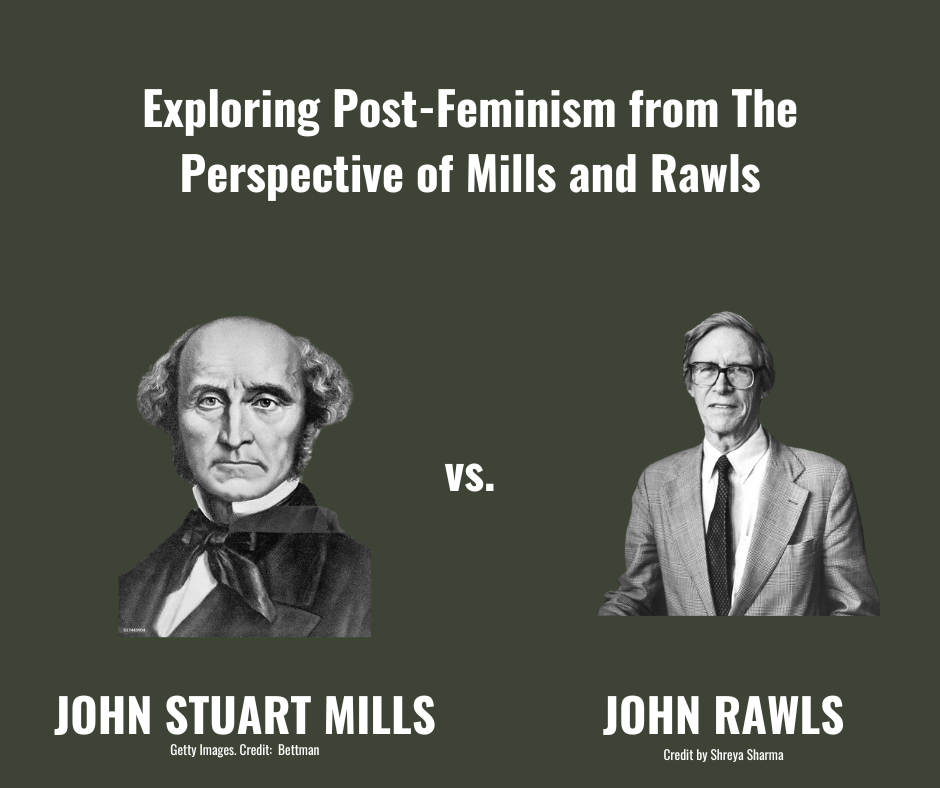
The quest for gender equality has evolved significantly over the past few decades. Two generations ago, feminist activists pursued freedom and equality in a dominantly patriarchal society, challenging the traditional division of labor in households, addressing workplace inequities, and striving for balanced familial roles. In contrast, today’s landscape witnesses a post-feminist generation of women confronting similar inequalities, albeit with distinct strategies. This generation witnesses a trend where women, for various reasons, choose to “opt out” of the workforce, prioritizing family over professional advancement.
This essay delves into the perspectives of John Stuart Mill and John Rawls to scrutinize this phenomenon, questioning its justice and implications for women’s autonomy and societal structure.
In his seminal work The Subjection of Women, John Stuart Mill articulates a vision of a society where gender does not dictate one’s opportunities or responsibilities in public or private spheres.
Mill argues for a familial structure that mirrors a just political system, advocating for a balance where neither partner exerts dominance over the other. This idea rejects any arrangement that inherently privileges men, positioning such dynamics as antithetical to societal progress and individual freedom. Mill’s practical philosophy, which champions the greatest happiness for the most significant number, suggests that societal arrangements should maximize overall well-being without compromising individual liberties. However, Mill’s acknowledgment of women’s economic vulnerability within traditional familial roles complicates this picture.
Despite advocating for women’s rights to education and professional careers, Mill recognizes the persistent influence of a patriarchal system that often relegates women to domestic roles, thereby limiting their autonomy and economic power.
From Mill’s perspective, the “opting out” movement could be seen as a regression, a symptom of societal failure to provide women with genuine choices beyond the dichotomy of professional career or domestic life. He would likely argue that this phenomenon does not contribute to the “greatest happiness,” as it restricts individual freedom and reinforces gender imbalances.
Yet, Mill acknowledges the complexity of societal evolution, suggesting that true equality requires a cultural shift in understanding and valuing women’s roles within and outside the household.
John Rawls’ theory of justice offers a distinct but complementary critique of the “opting out” trend. Rawls stresses the importance of equality and the fair distribution of opportunities, aiming to create a society where social and economic inequalities are structured to aid the least advantaged individuals.
In light of Rawls’ theory, the post-feminist movement highlights a systemic failure to ensure equal opportunities for all. The societal expectation for women to assume primary responsibility for domestic tasks undermines their professional prospects and contravenes Rawls’ vision of a just society.
According to Rawls, a fair society would not disadvantage any group for the benefit of another, suggesting that the existing structure, which pressures women to “opt-out,” is inherently unjust. Furthermore, Rawls’ “original position” concept underlines the importance of designing societal systems without knowing one’s place. This thought experiment reinforces the argument against a societal arrangement that inherently disadvantages women, advocating for reevaluating work and family roles to ensure a truly equitable division of labor and opportunities.
In conclusion, Mill and Rawls offer valuable insights into the “opting out” phenomenon, framing it as a reflection of more profound societal injustices rather than a mere matter of individual choice. This analysis suggests that achieving gender equality requires more than just providing women with the option to work or stay at home; it necessitates a comprehensive restructuring of societal norms, workplace policies, and familial expectations.
As we strive towards a society that values and supports all individuals’ choices, we must challenge traditional paradigms and work towards an equitable distribution of roles and responsibilities. Only then can we hope to realize Mill’s ideal of a society without power imbalances and Rawls’ vision of a just social order where everyone has the freedom and opportunity to pursue their conception of a good life.
Works Cited
- Belkin, Lisa. “The Opt-Out Revolution.” The New York Times, October 26, 2003.
- Jesella, Kara. “Mom’s Mad. And She’s Organized.” The New York Times, February 22, 2007.
- Lowry, Richard. “Time, at Last.” National Review Online, March 19, 2004.
- Mill, John Stuart. On Liberty and Other Essays. Oxford University Press, New York, 1991.
- Rawls, John. Justice as Fairness: A Restatement. Edited by Erin Kelly, The Belknap Press of Harvard University, Cambridge, MA, 2001.
- “The Future of Feminism.” CQ Researcher, April 14, 2006.
 OFF THE BEATEN PATH
Leave a comment