
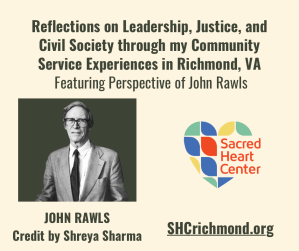
Featuring Perspective of John Stuart Mills
Patrick DePeters
May 2008
Which paradigm or theory of justice has been most helpful for understanding and evaluating your service experience? Why?
—
This essay is a reflection on my time volunteering for the Sacred Heart Center (SHC) in Richmond, VA. For underprivileged families in Richmond, the accessibility and affordability of high-quality educational and social development opportunities have been scarce, to say the least, for quite some time.
That is to say, we have largely ignored our responsibilities to serve the least advantaged members of society. Disturbingly, these “least advantaged” are characterized as such in large part due to a dark history of systemic oppression in the historic city of Richmond specifically (the former capital of the confederacy, a bulwark in the Civil War), and in the United States more broadly.
During this past semester (Spring 2008), I volunteered at the Sacred Heart Center (SHC), located in one of Richmond, Virginia’s poorest and most crime-prone areas, hoping to give back to underprivileged communities (i.e. Black, Latino) that have been systematically denied so much for so long.
The SHC describes itself as follows: SHC has offered comprehensive education and support services for Latino families and individuals for over 12 years and we provide the children’s programs, transportation, language access, long-term support, and cultural affirmation that allow Latino individuals and families to overcome the barriers that prevent them from connecting their talents and skills to opportunities and resources.”
John Rawls, would celebrate the SHC because it provides primary goods to a population that never would have expected them in the first place due to the unjust position afforded to them in our past and present society.
Without the SHC, the citizens of this community would never believe that they can have “primary goods” or an abundant, fulfilling life or fulfill a universal human desire for self-actualization.
To have a “Just” society, Rawls believes we cannot ignore inequalities in people’s life prospects.
We need specialized and resourced programs like those afforded by the SHC to help alleviate the egregious and systemic injustices that will fester unabated without sufficient intervention.
When I sat shot-gun in the First Precinct police cruiser a few weeks ago, I witnessed, for the first time, the horrors that make up the “projects” in the city of Richmond, Virginia.
Uniformly black and Latino low-income families occupy the government-sponsored housing. Most of these residents are uneducated beyond a high school level, and plenty still are unemployed or underemployed.
In this community, single parents are not an exception. The school-age children, comprising almost a quarter of this population, will not be expected to go to college, unlike many, if not most, of their counterparts “across the tracks.”
Most well-meaning parents there can only hope that their children will finish high school before succumbing to the drug and crime-infested world that tragically and ubiquitously surrounds them. Even though this depiction is generalized and perhaps alarmist, one should understand that these people are in a critical state, and they need and deserve more support.
John Rawls was concerned with injustices such as these because they deny the least advantaged the right to expect a fair amount of primary goods over a complete life.
According to Rawls, “Primary Goods” are:
Various social conditions and all-purpose means that…enable citizens adequately to develop and fully exercise their two moral powers, and to pursue their determinate conceptions of the good…these goods are things citizens need as free and equal persons living a complete life…(58).
For the low-income citizens downtown, there are a variety of “social conditions” that prevent them from “developing [ing] and fully exercising [ing] their two moral powers” (58).
The social conditions that impact these least well-off citizens lack at least four of the five primary goods that Rawls considers essential to a fair life. These include the freedom to choose one’s occupation, positions of authority, sufficient income and wealth, and a sense of self-respect. These conditions hinder the capacity for a conception of the good.
If these goods are by “free and equal persons living a complete life,” and the disadvantaged do not have them, they are systematically prevented the right to live a complete life.
Knowing this, it is our responsibility to provide an environment in which one’s moral powers can not only be developed but can also encourage people to think that they can expect more goods in the future.
The SHC’s mission recognizes this responsibility to help the most disadvantaged citizens have a fair shot at obtaining the “good.” It becomes much more challenging to ignore the responsibility if you see the problem in real life, as opposed to in the papers, or amidst cantankerous political discourse daily.
The police officers patrolling these neglected regions on a daily basis are intimately familiar with the people (knowing many if not most by their first name) and the conditions I am reporting here, just as those human beings who live it in their daily experience.
Moreover, if we look at the underprivileged population served by the SHC, most of the families do not live a complete life, according to Rawls. The families that walk through the doors of the SHC combat some of the most challenging obstacles that any family can encounter.
Most of these families, over sixty-five percent, according to the SHC, are headed by single parents, who alone must deal with conditions such as severe poverty, drug, and alcohol abuse, violent relationships, and must also care for their young children who require boundless time, energy, education, encouragement, and direction in their lives.
Alone and in some ways abandoned, these people cannot escape the cycle of disadvantage (illiteracy, low-wage jobs, etc.) because they are not able to access the equal *opportunities* necessary to go beyond the unjust cycle of poverty and inequality.
The administrators at SHC understand that, to be the most effective, they must gear their programs to fit the real needs of these disadvantaged people. Patrons of the SHC greatly benefit from the affordable daycare, academic tutoring, occupational training, and parenting classes provided daily.
Furthermore, the day-care and after-school programs, for instance, do not merely babysit the children. Still, instead, they challenge and support the kids academically, artistically, and socially to prepare them for school tomorrow and for the real world inside and outside the physical and psychosocial boundaries of their communities in the future.
Tragically, the chronic violence seen on the streets of the inner city of Richmond sometimes seeps into the SHC. So, we volunteer d to ensure that the children understand and abide by the center’s non-violent creed.
At the center, we realize that many children will return home to neglectful parents and conditions that are not conducive to learning. We must provide an environment where the children feel valuable and capable of achievement. Rawls believes that all deserve the opportunity to develop their “native endowments” and maintain a robust sense of self-worth.
Volunteers like me try to further this cause by standing in as mentors to teach, embrace, and learn. All the adults around the children try to promote self-respect, courage, discipline, and ambition, which effectively help them deal with and rise beyond their disadvantaged situations.
The disadvantaged people served did not realistically expect any “primary goods” over their lifetime before SHC helped them understand that they, too, deserve their dreams for primary goods and more.
The underperforming public schools and society at large have conditioned the children into thinking that their expectations (misrecognition) for the future are somewhat limited and inferior according to their social class.
In addition, as Rawls points out, “we asses our prospects in life according to our place in society, and we form our ends and purposes in the light of the means and opportunities we can realistically expect” (56).
Disadvantaged children, then, will likely view their purpose inferior to that of the more advantaged. By focusing on academic achievement and by rewarding good work, we hope to “encourage…attitudes of optimism and confidence in [each child’s] future” (57).
Moreover, Rawls asserts that background contingencies (social, natural, and lucky) should not restrict a citizen from the opportunity to achieve in a just society. At the SHC, we understood that these contingencies are stubborn and unable to be solved by one organization alone.
However, we can effectively transmit high expectations, supportive resources, and earnest positivity and encouragement for each child’s future. Fittingly, Rawls writes, “Among what affects the realization [of their natural endowments] are social attitudes of encouragement or support and institutions concerned with their early discipline and use” (57).
Of the five kinds of goods that Rawls recognizes, it is the fifth, which is the “social bases of self-respect” that the center advocates most. The children, just like their parents, need to have a “lively sense of their worth as persons” because, with self-confidence, they can effectively advance their life prospects. A secure sense of self-worth will hopefully “arouse further desire and aspiration in the future” (57-59).
The SHCs reinforce great expectations for the children and provide them with some of the resources needed to develop their moral powers. We hope they will grow up abandoning the idea of limited life prospects and pursuing whatever should make their lives happy and complete.
Rawls would support the programs at the SHC because they are conditioning and preparing children to overcome the background contingencies that would otherwise limit their life prospects.
The SHC not only aids children in developing and exercising their two moral powers, but it encourages them to understand and expect life prospects in the future. In a just society, all should at least have the opportunity to better themselves and expect a fulfilling life. Organizations such as the SHC are a step in the right direction for the millions of deserving children and their families sequestered to the fringes of opportunity in our American society.
Works Cited
Rawls, John. Erin Kelly, ed. Justice as Fairness: A Restatement. The Belknap Press of Harvard University, Cambridge, MA. 2001.
 OFF THE BEATEN PATH
Leave a comment